27 Feb 2026
This study was conducted under the ODIN consortium project “Strengthening Environmental Surveillance to Advance Public Health Action”, supported by the European Commission through Horizon Europe (Grant Agreement No. 101103253) and Global Health EDCTP3. The project aims to strengthen genomics and bioinformatics capacity and to develop wastewater and environmental surveillance (WES) systems that provide data-driven insights to support public health decision-making in Burkina Faso, the Democratic Republic of the Congo (DRC), Tanzania, and more broadly across sub-Saharan Africa.
Within the ODIN project, Work Package 2 focuses on setting up environmental surveillance systems for multiple human pathogens, with Task 2.4 dedicated to collecting environmental surveillance data in the three partner countries. The Finnish Institute for Health and Welfare (THL) leads this work in close collaboration with project country laboratories, including the Clinical Research Unit of Nanoro in Burkina Faso, the Centre for Research and Studies on Emerging and Re-emerging Diseases (CREMER) in the DRC, and the National Public Health Laboratory (NPHL) in Dar es Salaam and the National Institute for Medical Research (NIMR) Laboratory in Tanga, Tanzania.
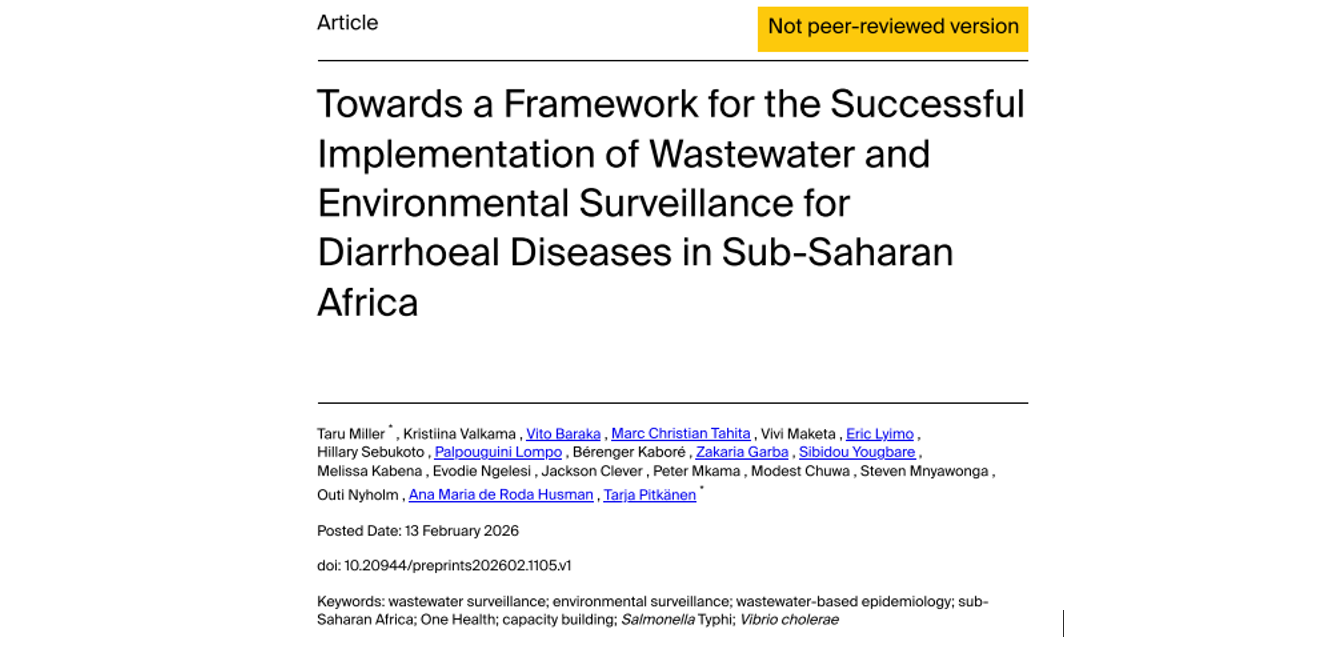
As diarrhoeal diseases continue to place a substantial burden on public health systems in sub-Saharan Africa, WES is gaining attention as a valuable complement to traditional clinical surveillance. In a new paper titled “Towards a framework for the successful implementation of wastewater and environmental surveillance for diarrhoeal diseases in sub-Saharan Africa”, researchers report on the implementation of a WES study conducted in Burkina Faso, the DRC, and Tanzania.
Between January and September 2025, monthly wastewater and surface water sampling campaigns were carried out across diverse sanitation contexts, alongside the collection of contextual clinical data. Together, these activities generated evidence on both the feasibility of WES and the challenges associated with its implementation in low-resource settings for Salmonella Typhi and Vibrio cholerae. Beyond pathogen detection, the study documents key operational and institutional lessons learned, as well as the role of stakeholder engagement throughout the project. By outlining both opportunities and implementation challenges, this work aims to support countries in harnessing WES as a complementary tool to strengthen early warning systems and improve public health decision-making.
Looking ahead, the project will continue analysing the results using whole genome sequencing (WGS), while also expanding investigations to additional targets identified within the ODIN project, including extended-spectrum beta-lactamase (ESBL)- and carbapenemase-producing (CP) Escherichia coli and Klebsiella pneumoniae. These efforts will further enhance understanding of antimicrobial resistance (AMR) and strengthen the role of WES in guiding public health interventions in sub-Saharan Africa.
Link to the preprint: https://www.preprints.org/manuscript/202602.1105 (doi: 10.20944/preprints202602.1105.v1)
Please Sign in (or Register) to view further.